


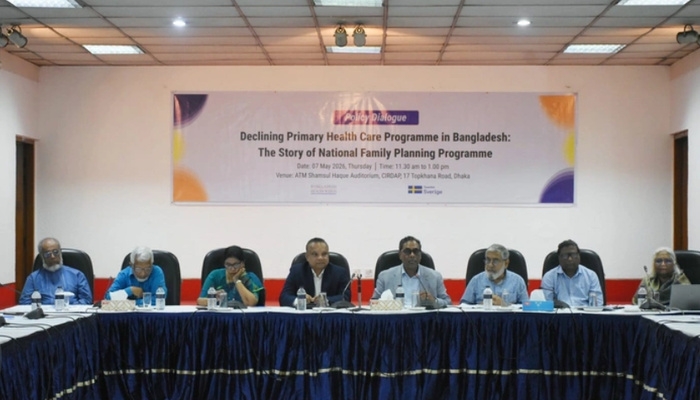
Bangladesh Health Watch organised a policy dialogue titled "Declining Primary Health Care Programme in Bangladesh: The Story of National Family Planning Programme" at the CIRDAP Auditorium in Dhaka. Senior public health experts, policymakers and other stakeholders took part and expressed deep concern about the growing crisis facing the national family planning (FP) programme, calling for swift action.
Speakers noted that Bangladesh's family planning programme, once held up as a global success story, now faces serious challenges. The total fertility rate (TFR), which stood at 7 at the time of independence, had fallen to 2.3 over five decades. However, participants warned that over the past 15 years the programme's momentum and effectiveness have weakened, putting this achievement at risk.
Dr Yasmin Ahmed traced the journey of the national family planning programme from independence to the present day. She identified the severe breakdown of the contraceptive supply system as one of the main causes of the current crisis. Because the Fifth Health, Population and Nutrition Sector Programme (HPNSP) was not approved, and the interim government later moved away from the sector programme approach, procurement of contraceptives has been stalled since July 2024.
The presentation noted that procurement of both short-acting and long-acting methods has remained suspended for more than two years, pushing the whole system into crisis. According to field-level information, less than 10 percent of the required supplies are reaching many areas. As a result, unintended pregnancies are rising and low-income women are being deprived of essential services.
Discussions also revealed that field-level activities have fallen sharply because of the supply shortage. The rate of home visits by field workers was 41 percent in 1993–94 but dropped to just 17 percent in 2022. Supply shortages at the Central Medical Stores Depot (CMSD) have eroded people's trust in field workers, and newly married adolescents and postpartum women are among those most affected.
Data from 2025 show that fertility is beginning to rise again: the national TFR has increased to 2.4, while the contraceptive prevalence rate (CPR) has started to decline.
Panellists proposed a range of solutions. Taslim Uddin Khan, Managing Director of the Social Marketing Company (SMC), said that more investment is needed in the family planning sector.
Senior public health expert Dr Obaidur Rob stressed the importance of keeping the population stable, making the best use of technology and effectively deploying the existing workforce.
Guests at the event reaffirmed the government's commitment to strengthening primary health care. State Minister for Health Dr M A Muhit said domestic financing for the health sector will be increased and that the health budget will be raised in the upcoming budget. Dr S M Ziauddin Haider, Special Assistant to the Prime Minister on health, emphasised improving the efficiency of the health system and urged people to pay greater attention to preventive health care.
Dr Ashrafi Ahmed, NDC, Director General of the Directorate General of Family Planning, said the ongoing procurement problem will be resolved by August.
Speakers collectively noted that nearly two-thirds of women of reproductive age want to limit the number of children they have. To avoid a long-term public health crisis, they said, the government must urgently resolve the procurement bottlenecks and revitalise the primary health care structure.
Citizen's Voice